Hyperbaric Oxygen Therapy: The Complete Guide
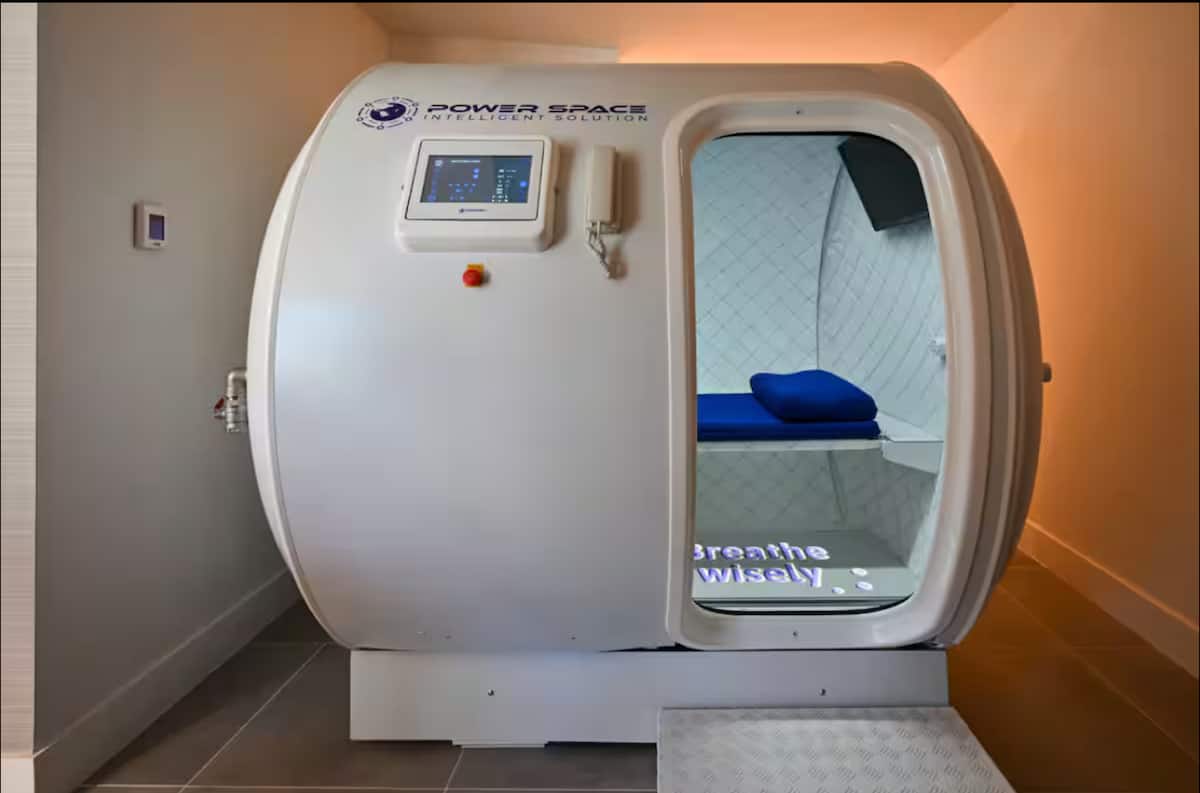
An elevator ride below the residence, a sealed chamber raises the pressure and fills the air with oxygen. Here is what hyperbaric oxygen therapy really is, what breathing oxygen under pressure can and cannot do, and how to try it sensibly.
01What hyperbaric oxygen therapy is
Hyperbaric oxygen therapy, almost always shortened to HBOT, is the plain-sounding practice of breathing oxygen while the air pressure around you is raised well above what you feel at sea level. You settle into a sealed chamber, the pressure climbs, and the air you breathe carries far more oxygen than an ordinary breath. Those two things happening at once — higher pressure and richer oxygen — drive a great deal more oxygen into your bloodstream than you could ever absorb standing on the beach outside. The word itself is the giveaway: hyperbaric simply means high pressure.
It is worth clearing up what HBOT is not, because it gets confused with gentler things. It is not an oxygen mask, and it is not the flavored-oxygen bar you may have seen at a ski resort. Sitting at normal room pressure and breathing extra oxygen does very little, for reasons the physiology section will explain. HBOT is defined by the pressure. Take the pressure away and you no longer have hyperbaric oxygen therapy at all — you just have someone breathing air in a tube.
The three letters also cover two different worlds that are easy to run together. In a hospital, HBOT is a genuine medical treatment, delivered at high pressure by trained staff for a short, specific list of conditions where the evidence is strong and the reasons are urgent. In a spa or a longevity-minded clinic, a gentler version is offered as a wellness service — something guests try for recovery, a clearer head, steadier sleep and a general sense of being restored. This guide is about that second world, and it will stay honest throughout about where the science is firm and where it is still catching up.
Two levers, pulled at once
Almost everything interesting about HBOT comes from combining two things that on their own are unremarkable.
- Pressure. The chamber raises the pressure on your body, usually measured in atmospheres. Medical chambers reach two to three times sea-level pressure; the milder chambers common in wellness settings sit much closer to it. More pressure means gases dissolve more readily into liquid — including the liquid part of your blood.
- Oxygen. At the same time, you breathe air far richer in oxygen than the roughly one-fifth that makes up a normal breath. With more oxygen available and more pressure to push it into solution, your plasma carries oxygen it normally never would.
At Amrit, hyperbaric oxygen therapy is one of the touchless, regenerative therapies in the wellness centre below the residence, offered alongside IV drips, red light and the PEMF mat. There is nothing athletic about it. You climb in, the chamber does the work, and an hour or so later you climb out having done nothing more strenuous than lie still and breathe slowly. What follows is the long version: where the idea came from, how it is thought to work, what the research supports, what a session feels like, who it suits, and who should talk to a doctor before booking one.
02From diving bells to the hospital ward
The idea that pressurized air might be good for the body is surprisingly old. In 1662, a British clergyman and physician named Nathaniel Henshaw built a sealed room he called a domicilium, using bellows to raise and lower the pressure inside, convinced that it would help with all manner of ailments. He had no way to know what he was doing, but he had the instinct. Through the 1800s, “pneumatic institutes” and compressed-air baths appeared across Europe, and well-off patients paid to sit in pressurized parlors for their lungs and their nerves.
The science caught up because of a hard, practical problem: divers and tunnel workers were getting sick. Men who labored in the pressurized caissons sunk to build bridge foundations came up with crippling joint pain that took the name the bends. The French physiologist Paul Bert worked out in the 1870s that the culprit was gas coming out of solution in the blood too quickly, and he also described how oxygen itself becomes toxic at high pressure — a limit that still shapes every session today. Not long after, the Scottish physiologist John Scott Haldane drew up the first staged decompression tables, so that divers could come up slowly and safely. Between them, these two lines of work turned pressure from a folk remedy into something you could measure.
A cautionary chapter
The field has its embarrassments, and it is worth telling them. In the 1920s an American named Orville Cunningham built enormous pressurized “tank hospitals,” including a six-story steel sphere in Cleveland, claiming that pressure alone could treat cancer, diabetes and much else. He had no evidence, the medical establishment pushed back, and the great steel ball was eventually scrapped for wartime metal. HBOT earned a whiff of quackery that it took decades to shed — a useful reminder that a real mechanism can be wrapped in claims that far outrun the data. It is a pattern worth remembering when you read the boldest wellness promises today.
The modern, evidence-based version grew out of two more sober lines of work. Navy and commercial diving medicine refined the use of oxygen under pressure to treat decompression sickness, so that today a diver who surfaces too fast off the Palm Beach reefs may be treated in exactly this kind of chamber. And in the 1950s and 1960s, surgeons and researchers — the Dutch surgeon Ite Boerema among them — showed that pressurized oxygen could keep tissue alive even when blood flow was compromised, in one famous experiment sustaining animals with remarkably little blood of their own. That opened the door to wound care, and from there came the carefully reviewed list of conditions for which hospitals use HBOT now. The wellness and longevity boom of the last two decades is the newest chapter, and by far the least settled — the reason a gentler chamber ended up in spas like the one below the residence.
03How breathing oxygen under pressure works
The physiology rests on a piece of basic chemistry called Henry’s law: the amount of a gas that dissolves in a liquid rises with the pressure of that gas above it. Open a bottle of sparkling water and the fizz escapes because you have dropped the pressure; a hyperbaric chamber does the opposite to the oxygen in your blood, holding more of it in solution than would otherwise stay there.
Under normal conditions, nearly all the oxygen you carry is locked onto hemoglobin inside your red blood cells, which are already about ninety-seven percent full. Simply breathing extra oxygen at sea level does little, because there is almost no room left on the trucks. This is exactly why an oxygen bar accomplishes so little. But the liquid part of your blood, the plasma, normally carries very little dissolved oxygen. Raise the pressure and flood the lungs with oxygen, and that dissolved fraction climbs steeply. Researchers showed decades ago that under enough pressure, plasma alone can carry enough oxygen to sustain tissue — oxygen that travels independently of your red cells and can seep into places blood flow struggles to reach, past a swollen wound or a narrowed vessel.
What the extra oxygen is thought to set off
That surplus of dissolved oxygen is thought to trigger a cascade of responses in the body:
- New vessel growth. Repeated cycles of high oxygen appear to prompt the body to build new small blood vessels over time, a process called angiogenesis, which is central to how HBOT helps stubborn wounds close.
- Less swelling. High oxygen causes blood vessels to narrow slightly, which can reduce swelling in injured tissue without starving it, because so much oxygen is dissolved in the plasma to compensate.
- Infection fighting. Oxygen-rich tissue is hostile to certain bacteria, and it helps white blood cells do their killing work.
- Repair signals. Sessions seem to mobilize the body’s own repair and stem cells and to stimulate the fibroblasts and collagen that rebuild tissue.
- A gentler reperfusion. When blood returns to tissue that was starved of it, the rush can cause its own damage; HBOT is thought to blunt some of that injury.
Those mechanisms are well established for healing damaged tissue, and they explain the medical uses honestly. The more speculative claims — that repeated sessions slow aging, lengthen the protective caps on our chromosomes, or clear the fog of a hard week — rest on a much thinner and more preliminary base of research, often from a single group of investigators whose findings have not yet been widely repeated. It is fair to say the machinery is real and interesting. It is not fair to assume every benefit people hope for follows automatically from it.
A note on dose and timing
One more honest caveat about the physiology: more is not automatically better. Oxygen behaves like a drug, and above certain pressures and durations it turns toxic, which is why medical protocols are so precise about how much and how long. The body also seems to respond to the pattern of exposure — brief, repeated surges of high oxygen followed by a return to normal — more than to any single long soak. So even where the mechanisms are real, the effect depends on getting the dose right, and a process that closes a wound over many careful sessions is not a switch you can flip once for a burst of vitality.
04What the evidence does and doesn't say
This is the section to read slowly, because HBOT is a case where the gap between proven medicine and wellness marketing is unusually wide, and honesty matters more than enthusiasm. Both things are true at once: it is a rigorously evidenced treatment for some conditions and an unproven, hopeful practice for most of the reasons people try it at a spa.
Where the evidence is strong
For a defined set of medical conditions, hyperbaric oxygen is an established, reviewed treatment — recognized by hyperbaric-medicine societies and, in the United States, often covered by insurance. These include:
- Decompression sickness and arterial gas embolism — the diving injuries the chamber was built to treat.
- Serious carbon-monoxide poisoning.
- Certain non-healing wounds, especially diabetic foot ulcers that have not responded to standard care.
- Radiation injury to tissue after cancer treatment.
- Crush injuries, compromised skin grafts and flaps, gas gangrene, some severe infections, and certain cases of sudden hearing loss.
In these situations the benefit is real and sometimes life-saving. Notice the common thread: they involve tissue that is starved of oxygen, and pressurized oxygen solves a specific, physical problem. That is the sturdy heart of the field.
Where the evidence is thin or emerging
The reasons most people try HBOT at a spa — recovery from training or travel, energy, focus, sleep, skin, a general anti-aging hope, or lingering symptoms after an illness — sit on far shakier ground. Some early studies, including work on brain injury, post-viral fatigue, fibromyalgia and markers of cellular aging, have reported encouraging results. But many are small, come from a single center, lack a convincing placebo group, or have not yet been repeated by independent teams. Blinding is a real problem here: it is hard to hide from someone that a chamber is pressurizing around them, which makes it hard to separate the oxygen from the expectation. Reviews of the wellness uses tend to reach the same careful verdict — promising in places, not proven, more and better trials needed.
The responsible way to hold this is simple. HBOT is a serious therapy for specific medical problems and a well-tolerated, still-unproven wellness practice for everything else. It is not a cure for any disease, it is not a replacement for care your doctor provides, and anyone promising that it reverses aging or fixes a chronic illness is getting well ahead of the science. Enjoy it for what it is, keep your expectations grounded, and let the research mature at its own pace.
How to read the claims you'll see
Because the promise is large and the proof is uneven, wellness HBOT attracts confident marketing. A few habits keep you grounded. Ask whether a specific claim comes from studies in people or from cell and animal work, which often does not translate. Ask whether the research used a real sham-pressure comparison or simply tracked how volunteers said they felt. Be wary of any single clinic that is the sole source of a dramatic finding until others have reproduced it. And treat testimonials, however sincere, as stories rather than evidence — they cannot separate the oxygen from the rest, they never show the people who felt nothing, and they are the easiest thing in the world to collect.
Under pressure, oxygen stops relying on your red blood cells and simply dissolves into the liquid of your blood, reaching places an ordinary breath never could.
On hyperbaric oxygen at Amrit
05Hard chambers, soft chambers and the pressure question
Not all hyperbaric chambers are the same, and the differences matter enough that you should know which kind you are stepping into. Broadly, there are two families, and the word “hyperbaric” on a spa menu can mean either.
Medical, high-pressure chambers
Hospitals and hyperbaric clinics use rigid, high-pressure chambers built to reach two to three times sea-level pressure while delivering pure oxygen. Some are large enough to seat several people, with an attendant inside and everyone breathing oxygen through a mask or a clear hood; others are single-person acrylic tubes filled entirely with oxygen. These are the chambers behind the strong medical evidence in the previous section. They are also tightly controlled for fire safety, because pure oxygen under pressure makes almost anything burn readily, and their sessions often build in short “air breaks” to keep the oxygen dose below the point where it can become toxic.
Mild, low-pressure chambers
The chambers that spread through the wellness world are usually gentler: softer or portable units that reach only slightly above sea-level pressure, often fed by an oxygen concentrator rather than a tank of pure oxygen. This milder approach is frequently marketed as “mild HBOT,” or mHBOT. It is more comfortable, easier to run, and much less demanding to operate safely.
Here is the honest tension. The impressive medical results were nearly all produced at the higher pressures and oxygen concentrations of the first family. Whether the lower-pressure wellness version delivers the same physiological changes is debated, and the high-quality evidence for it is limited. Some practitioners argue even modest pressure does meaningful work; skeptics argue the dose is too small to matter much. The truthful answer today is that we do not fully know.
- Ask what you are getting. A good provider will happily tell you the chamber type, the pressure it reaches, and whether you breathe pure oxygen or concentrated air. Vague answers are a small red flag.
- Match it to your purpose. Anything medical belongs with a physician and a clinical-grade chamber, not a spa. For relaxation and general wellbeing, a milder chamber is a reasonable, low-risk thing to try.
- Read claims with a cool head. As a rough rule, the gentler the chamber, the more cautious you should be about the size of the promises attached to it.
- Weigh the commitment. Wellness protocols often suggest a course of many sessions. That is a real investment of time; decide whether the reported payoff is worth it to you before you sign on for a series.
None of this is a reason to avoid a wellness session. It is a reason to walk in informed, so your expectations match the machine you are using.
A word on comfort and safety
Whichever family you meet, two practical things shape the experience. Comfort comes down to the ears and the space: if you equalize easily and do not mind a snug tube, a session is relaxing, and a larger cabin removes even that concern. Safety comes down to the fire rule, which is why every reputable operator is strict about what goes into the chamber and why you should never bend it — no lighters, no loose electronics, no petroleum-based products on your skin or in your hair. A provider who takes that seriously is one you can trust with the rest of the session.
06What a session is like
A hyperbaric session is calm and, for most people, easy. It usually runs about sixty to ninety minutes at pressure, plus a few minutes on each end to compress and decompress. Here is the shape of it, start to finish.
First comes a short screening. Staff will ask about your health, recent surgeries, medications, and whether you have a cold or congestion, and they will explain how to clear your ears. You change into simple cotton clothing; because of the fire risk, you leave behind lighters, electronics, watches, lotions, oils and anything petroleum-based, including many hair products. Then you settle into the chamber — lying in an acrylic tube, or seated in a larger cabin — and it seals with a reassuringly solid sound.
As the pressure rises, the air warms slightly and you feel your ears fill, exactly like an airplane descending. This is the one part that asks something of you: you have to equalize the pressure in your ears. Once you are at depth, the warmth fades, the chamber settles, and there is nothing to do. People nap, rest, listen to something, or simply breathe. In a larger cabin you can talk to the operator throughout, and in a single tube you can signal them at any time. At the end, the pressure is released slowly, your ears may pop again, and you step out.
Clearing your ears — the one skill worth learning
The most common discomfort in HBOT is ear pressure during the descent, and it is easily managed if you stay ahead of it. Equalize early and often as the pressure climbs, rather than waiting until it pinches. Useful techniques include:
- Swallow or yawn — the simplest way to open the tubes behind your ears; sipping water helps.
- Pinch and blow gently — hold your nose, close your mouth, and blow softly until you feel your ears click. Gently is the operative word; never force it.
- Wiggle your jaw from side to side, which many people find opens their ears with almost no effort.
Tell the operator the moment your ears feel tight; they can slow the pressure change or pause until you catch up, which is completely routine. Afterward you may feel pleasantly tired, a little hungry, or perfectly normal. A small note worth knowing: people who do many sessions in a short span sometimes notice a temporary shift in their eyesight, usually a mild, reversible near-sightedness that settles back over the weeks after they stop. Bring water, since a chamber is drying, and give yourself an unhurried place to land rather than rushing straight into a packed afternoon.
Before and after
A little preparation makes the hour smoother. Eat something light beforehand so you are neither full nor famished, use the restroom first since you cannot easily step out mid-session, and go in with clear sinuses — if you are stuffed up, this is the day to reschedule rather than force it. Afterward, keep drinking water, and do not schedule anything demanding for the next hour or two; the calm the session builds is easily undone by rushing straight from the chamber into a busy afternoon. If you feel light-headed on standing, which is uncommon, sit back down and let the staff know.
07What people say they get from it
Set aside the clinical indications for a moment and listen to what wellness guests report, because that is why the chamber ends up in a spa in the first place. The accounts are consistent, even where the controlled science has not caught up to them, and it is fair to take them seriously as experiences while staying skeptical about mechanisms.
People commonly describe:
- A sense of recovery. Athletes and hard-training travelers often say they feel less sore and bounce back faster after a session, folding it into a rest day between efforts.
- Mental clarity. A lighter, clearer head is one of the most frequent reports — the feeling of the fog lifting after a demanding stretch of work or travel.
- Better sleep. Some people find they sleep more deeply the night after a session, though this is easy to confuse with the effect of an hour spent lying quietly with no phone.
- Steadier energy. Not a jolt, but a sense of having a little more in reserve over the following days.
- Calm. An hour sealed away with nothing to do and nowhere to be is restorative on its own terms, whatever the oxygen is or is not doing.
Why the reports and the research diverge
It is worth being clear-eyed about why so many people feel a real benefit while the controlled evidence for general wellness stays thin. A hyperbaric session bundles several things together: an enforced hour of stillness, a break from screens and demands, the ritual of doing something deliberate for your body, the deep breathing you naturally fall into, and, yes, whatever the oxygen itself contributes. Untangling the chamber from the rest of that package is exactly what good studies try to do and exactly what is hard to pull off.
That does not make the experience less pleasant or less worthwhile. It means the sensible framing is honest: many people enjoy how they feel afterward, some of that may be the oxygen and much of it is simply rest done well, and none of it should be mistaken for treating an illness. If wellness guests tend to describe a gradual sense of benefit over a course of visits rather than a single dramatic result, and if HBOT becomes a calm anchor in your week that you feel better for, that is a good enough reason on its own — without needing to oversell what is happening inside the chamber.
How often, realistically
If you decide it belongs in your routine, expect a gradual relationship rather than a one-off fix. On a week-long stay, one or two unhurried sessions woven into your slower days is a sensible rhythm and plenty to learn whether you enjoy how you feel. The people who report the most tend to be those under real strain — hard training, heavy travel, a punishing schedule — for whom an enforced hour of stillness would help almost regardless of the chamber. That is not a knock on HBOT; it is a reminder to credit the rest and the routine alongside the oxygen, and to judge it by how you feel rather than by what you were promised.
08Who it suits — and who must ask a doctor first
For most healthy adults, a wellness hyperbaric session is low-risk and well tolerated. But HBOT has more real contraindications than a sauna or a salt room, and this is a therapy where the screening questions matter. Take them seriously rather than waving them through.
Who tends to enjoy it
It suits people looking for a quiet, low-effort hour: travelers shaking off a long flight, active guests using a rest day well, and anyone drawn to the calm of an enforced pause. It layers naturally into a wider wellness stay and asks nothing physical of you.
The firm no
There is one true absolute contraindication: an untreated collapsed lung (a pneumothorax). Changing the pressure around trapped air in the chest can be dangerous, which is why any reputable provider screens for it. This is not a place to be casual or to omit part of your history.
Ask your doctor before you book if you
- Have a lung condition such as significant COPD, poorly controlled asthma, or any history of air trapping or blebs in the lungs.
- Have had recent ear, sinus, chest or eye surgery, or currently have a cold, congestion or a sinus infection — if you cannot clear your ears, you should reschedule rather than push through.
- Have a history of seizures, an uncontrolled high fever, uncontrolled high blood pressure, or a pacemaker or implanted device (confirm it is rated for pressure).
- Struggle badly with enclosed spaces; some single tubes feel snug, though larger cabins are much easier.
Medications and pregnancy
A few drugs interact with high-pressure oxygen. Certain chemotherapy agents in particular — and some other prescriptions and a drug used for alcohol treatment — are cautioned against with HBOT, so anyone in active cancer treatment or on a complex medication list should clear it with their oncologist or physician first. Bring your medication list to the screening and do not leave anything off. And pregnancy is a clear reason to hold off: outside of a genuine medical emergency handled by doctors, hyperbaric oxygen is generally avoided in pregnancy, so if you are or might be pregnant, ask your doctor rather than book.
None of this should scare off a healthy guest who simply wants a quiet, oxygen-rich hour. It is a reminder that HBOT is more medical in character than most spa services, that a good provider will ask real questions before letting you in, and that the right answer to any doubt is a quick conversation with your own doctor, not a guess in the changing room.
The side effects worth knowing
Even for people cleared to go in, HBOT is not entirely without effects. Ear or sinus barotrauma — discomfort or, rarely, minor injury from the pressure change — is the most common, and it is almost always preventable by equalizing early and speaking up when your ears feel tight. Some people feel briefly tired or light-headed afterward. Repeated high-pressure courses can cause the temporary vision change mentioned earlier, and, very rarely, oxygen at high enough doses can provoke a seizure, which is why medical chambers control the dose so carefully. At the milder wellness pressures these risks are lower, but they are exactly why screening is not a formality to wave through.
09Hyperbaric oxygen in the regenerative suite below the residence
What makes the chamber here easy to try is where it sits. Hyperbaric oxygen therapy is one of the touchless, regenerative therapies within the wellness centre downstairs from OASENA — a roughly one-hundred-thousand-square-foot facility with twenty-two treatment rooms, built around the idea that recovery should feel like part of a stay rather than an errand across town. You do not book a clinic in a strip mall, sit in traffic, or drive home afterward with your ears still adjusting. You take an elevator.
How it fits with the rest
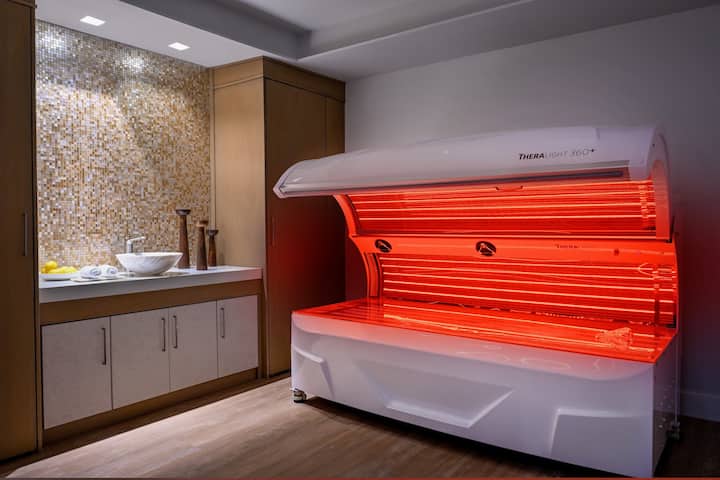
The regenerative suite gathers the therapies that ask nothing of you but time. Alongside the hyperbaric chamber sit IV therapy, including a NAD+ longevity drip, red light therapy, the PEMF mat, dry flotation and the multi-modality Ammortal Chamber. They share a philosophy — touchless, restful, aimed at how you feel over the following days rather than at a single dramatic moment — and they layer naturally into a slow morning. Many guests treat the hyperbaric session as the still center of a recovery block and add a lighter therapy on either side.
A few practical notes for using it here:
- Preferred rates. Residence guests receive preferred rates at the wellness centre, and access is subject to the resort’s terms and scheduling.
- Screening comes first. Expect the same health questions described earlier. If you are congested, have a lung or ear issue, are pregnant, or are on medications you are unsure about, raise it when you book so the staff can guide you rather than turn you away at the door.
- Book ahead. A hyperbaric session runs the better part of an hour or more and needs an operator, so it rewards planning rather than a walk-in whim — especially in the busy winter high season, when the spa fills.
- It is a wellness service. The team offers HBOT as part of a wellness circuit, not as medical care. For a medical condition, that belongs with your own physician and a clinical program.
The residence itself is privately owned and is not operated by or affiliated with the resort; the wellness centre is a neighbor you happen to live above for the length of your stay. That proximity is the real luxury. A therapy that elsewhere would mean an appointment, a commute and a chunk of a day becomes something you fold into a morning before the beach, then ride the elevator home to your own kitchen and balcony. Few settings make an unhurried session this simple to arrange.
Making the most of the setting
Because everything sits under one roof, the smart move is to think in blocks rather than single appointments. Ask the spa to schedule the hyperbaric session with a gentler therapy on either side, so the morning flows instead of scattering across the day. Arrive a few minutes early to change and settle, resist the temptation to bring your phone in, and let the staff walk you through the ear-clearing before the door seals. And because winter is the busy season on the island, reserve early in your stay — the best slots, mid-morning before the beach, tend to go first.
10Folding a session into a Singer Island day
The nicest way to use the chamber is unhurried, with the rest of the island arranged around it rather than crammed against it. A little planning turns a single session into a restorative morning instead of one more box to tick.
A recovery morning that works
Come down mid-morning, well hydrated and lightly fed — not on an empty stomach, and not straight off a big brunch. Do the hyperbaric session first, while you are fresh and can clear your ears easily, and keep it as the calm anchor of the block. Afterward, add something gentle rather than strenuous: a stretch of red light, twenty minutes on the PEMF mat, or simply the relaxation lounge with a glass of water. Save a hard sauna-and-plunge round for another part of the day or another day entirely, since you do not want to arrive at the chamber already dehydrated from the heat. Then go back up, open the balcony doors, and let the Atlantic finish the job the chamber started.
A note the divers will appreciate
There is a neat piece of local symmetry here. Singer Island sits beside some of the best shore diving in the country, from the Blue Heron Bridge to the offshore reefs, and the hyperbaric chamber is the very technology that treats divers who surface too quickly and get decompression sickness. If your trip mixes diving with wellness, keep the two worlds sensibly apart: this is a relaxation session, not dive medicine. Tell the staff about any recent diving, follow proper surface intervals, and never treat a spa chamber as a shortcut around dive-safety rules. Anything to do with actual decompression is a question for a dive professional, not a spa desk.
Weaving it into a longer stay
- Arrival day. A quiet session can be a pleasant reset after a long flight, paired with an early night and a simple dinner in rather than a heavy meal out.
- Midweek. Slot it into a slower day between beach mornings and boat afternoons, when you want an hour of stillness rather than another outing.
- Pair, don’t stack. One or two thoughtful therapies in a morning beats trying to sample everything at once; the goal is to feel rested, not booked solid from dawn.
- Leave a soft landing. Plan the hour after for the terrace, the pool or a nap, not for a drive across the bridge to a lunch reservation.
Used this way, hyperbaric oxygen is less a treatment you undergo than a slow hour you give yourself, tucked below the residence, before the sand and the water and the long light of a Singer Island afternoon take over the rest of the day.
A sample slow morning
If it helps to picture it: wake without an alarm, take coffee and something light on the balcony, and head down around ten. Clear your ears through the compression, then settle in for the hour with nothing to do and nowhere to be. Come out, drink water, and spend twenty easy minutes under the red light or on the mat. Ride back up, change into beach clothes, and walk down to the private sand for the afternoon, or drift out to the pool. Nothing about the day is strenuous, which is exactly the point — the chamber sets the tone, and the island keeps it.
Common questions
Is hyperbaric oxygen therapy safe?
For healthy adults, a wellness session is generally well tolerated, and the most common issue is temporary ear pressure that you manage by clearing your ears as the chamber pressurizes. That said, HBOT has real contraindications: it is not appropriate with an untreated collapsed lung, certain lung conditions, active congestion or a cold, some medications, or during pregnancy. A good provider screens you first, and if you have any doubt you should <strong>ask your doctor</strong> before booking.
Will it help me recover, sleep better or feel younger?
Many people report exactly those things, and an hour of restful, oxygen-rich stillness may help. But be candid with yourself: the strong evidence for HBOT is in specific medical conditions, while the research on general recovery, energy, sleep and anti-aging is limited and still emerging. Treat it as a pleasant, well-tolerated wellness practice, not a cure or a proven fix.
What is a session like, and do I need to do anything?
You lie or sit in a sealed chamber for roughly sixty to ninety minutes. As the pressure rises you clear your ears, just like on a descending plane, by swallowing, yawning or gently pinching your nose and blowing. After that there is nothing to do but rest and breathe. Wear simple cotton clothing and leave electronics, lighters and lotions outside, since oxygen under pressure is a fire risk.
Should I skip it if I have a cold, or if I'm diving?
Yes to the cold — if you are congested you may not be able to equalize your ears, so reschedule. If your trip includes diving, tell the staff about any recent dives and keep the two separate: this is a wellness session, not dive medicine. And if you have a lung condition, recent ear, sinus or eye surgery, a seizure history, are on chemotherapy or other complex medications, or are pregnant, <strong>ask your doctor first</strong>.
A note on wellness & health
This guide is general information about therapies offered at the resort spa, not medical advice, diagnosis or treatment. Wellness services are elective and results vary from person to person. Talk with a qualified healthcare professional before starting any new therapy, especially if you are pregnant or managing a medical condition. OASENA is privately owned and is not operated by, affiliated with, or endorsed by Amrit Ocean Resort & Residences. Spa access is offered to residence guests at preferred rates, subject to the resort’s terms and availability.

Your quiet address above the Atlantic
OASENA is a private two-bedroom home on the twelfth floor of the Happiness Tower — floor-to-ceiling ocean views, a sweeping balcony, and this entire wellness world an elevator ride below.
OASENA is a privately owned residence within Amrit Ocean Resort & Residences and is not operated by, affiliated with, or endorsed by the resort. See credits & notes.