Halotherapy: A Complete Guide to Dry Salt Therapy
A short elevator ride below the residence, a dim room glows against a wall of salt brick while a fine, dry mineral mist fills the air. Here is what halotherapy is, where it came from, what the science honestly supports, and how to use the salt chamber well.
01What halotherapy is
Halotherapy is the simple practice of sitting in a room and breathing air that carries a fine mist of dry, ground salt. A device called a halogenerator grinds pharmaceutical-grade sodium chloride into particles too small to see and disperses them into a quiet, temperature-controlled space. You settle into a chair, you breathe the way you always breathe, and over twenty to forty minutes those tiny particles drift through the air, land on your skin, and travel down into your airways. The name comes from halos, the old Greek word for salt. That is the whole of it: salt, air, and a stretch of time with nothing to do.
It is worth saying clearly what halotherapy is and is not, because the salt-room world is full of overreach. This is dry salt therapy, which is different from the wet, misted saline sometimes used in a clinic or with a nebulizer. It is a wellness practice with a long folk history and a pleasant feel, not a medical treatment, and it does not replace an inhaler, an antibiotic or anything your doctor has prescribed. People come out of a good session saying their chest feels a little clearer and their skin feels clean and soft. Those reports are real and common. What the science can and cannot back up is a separate question, and this guide takes it on honestly further down.
The room itself
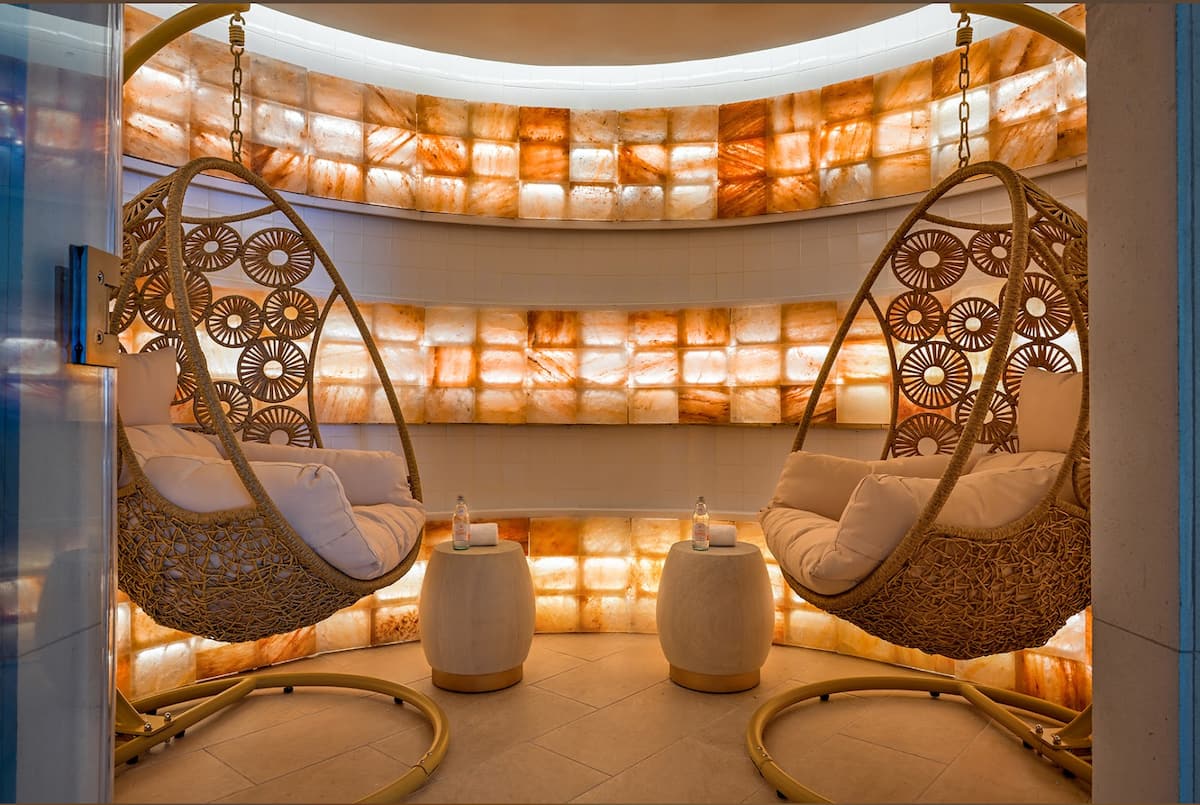
At Amrit, halotherapy has a home rather than a machine in a closet. The salt inhalation chamber is one station on the hydrothermal circuit a short elevator ride below OASENA — a dim, warm room set against a wall of backlit salt brick that glows a soft amber. You do not lie under a machine or wear anything special. You settle into a comfortable chair, the light is low, the halogenerator hums somewhere out of sight, and the only task in front of you is to breathe slowly and let the room do its quiet work.
The plainest way to describe the appeal is this: a salt room is a careful attempt to bottle a sea breeze. For as long as people have lived near coasts, they have believed that salt air is good for the lungs, and they have sent the congested and the run-down to the seaside to breathe it. Halotherapy takes that old intuition indoors, concentrates it, and holds it steady in a controlled room so you get a consistent dose rather than whatever the wind happens to bring. On the twelfth floor above the Atlantic, there is a certain symmetry to that — the manufactured version downstairs, the original a slider-door away upstairs.
- It asks nothing of you. Unlike the sauna or the cold plunge, there is no heat to tolerate and no shock to brace for. You simply sit and breathe.
- The dose is small. The amount of salt you take in over a session is tiny — nothing like the salt on your dinner or the sting of a wave up the nose.
- It rewards stillness. Much of what people value is inseparable from the quiet: a screen-free half hour in a warm, dark room that exists only for slow breathing.
Read the rest of this guide as a walk around the subject: where the idea came from, what salt is thought to do in the airways, what the research honestly supports and what it does not, what a session feels like, who it suits, who should check with a doctor first, and how to fold twenty quiet minutes in the salt room into a day on Singer Island.
02A cure that started in a salt mine
The story of halotherapy usually begins underground, in 1843, in the salt mines of Wieliczka in what is now southern Poland. A physician named Feliks Boczkowski, who worked with the miners, noticed something he thought worth writing down: the men who spent their long days hewing salt in the deep galleries seemed strikingly free of the coughs and lung complaints that plagued other laborers of the era. He put his observation on paper and suggested the salty underground air had something to do with it. It was the first written link between breathing salt air and healthier lungs, and everything that followed grew from that seed.
Over the following decades, the idea took root across Central and Eastern Europe. Health resorts grew up around old salt workings, and patients with breathing troubles descended into the mines to sit for hours in the cool, still, salt-laden air. The practice earned a name — speleotherapy, from the Greek for cave — and dedicated underground sanatoriums opened in salt and karst caves from Poland to Ukraine to Romania. Some of them still operate today, with patients riding down in mine elevators to spend afternoons reading, resting and breathing far below the surface.
From bomb shelters to the halogenerator
A second thread runs through the Second World War. In parts of Germany and Eastern Europe, deep salt caves and mines were used as bomb shelters during air raids, and observers reported that people who sheltered in them — sometimes for long stretches — often found their breathing eased while they were underground. Whether that was the salt, the still air, the stable humidity or simply days of forced rest is impossible to untangle now, but it added to the growing folk conviction that salt air did something good for the chest.
The practical problem with speleotherapy was obvious: not everyone can travel to a salt mine and climb down into it. So in the mid-twentieth century, researchers in the Soviet Union and Eastern Europe set out to bring the mine to the patient. They developed the halogenerator — a machine that grinds salt into fine particles and blows them into an ordinary room — so the salt cave could be recreated above ground, in a clinic or a spa, without the mine. That device is the direct ancestor of the one humming quietly behind the wall in every modern salt room, including the chamber below the residence.
- 1843, Wieliczka. Feliks Boczkowski records that salt miners seem unusually free of respiratory trouble — the founding observation.
- Late 1800s onward. Speleotherapy spreads; sanatoriums open inside working and disused salt mines across Europe.
- 1940s. Salt caves double as wartime shelters, and sheltering people again report easier breathing underground.
- Mid-1900s. The halogenerator is developed to bring dry salt aerosol into ordinary rooms — the birth of modern halotherapy.
So when you settle into a chair against a glowing brick wall on Singer Island, you are sitting at the far end of a long line that runs from a nineteenth-century mine doctor, through cave sanatoriums and wartime shelters, to a small grinding machine in a Florida spa. The room is thoroughly modern and the salt is pharmaceutical-grade, but the intuition behind it — that there is something restorative in breathing salt air — is old, stubborn and shared across many cultures. That long history is worth holding in mind as we turn to the science, because the tradition ran for well over a century before anyone tried to measure it properly.
03How it is thought to work
The proposed mechanisms behind halotherapy are easy to follow, even where the proof behind them is uneven. They rest mostly on the plain physical and chemical behavior of salt, and it helps to take them one at a time rather than as a single grand claim.
Salt attracts water. Sodium chloride is hygroscopic, which is the fact at the center of every halotherapy theory. It pulls moisture toward itself. The idea is that when microscopic salt particles land on the lining of your nose, throat and airways, they draw a little water to the surface, which may help loosen and thin the mucus sitting there. Thinner mucus is easier to move and clear, and a lot of the congested, stuffy feeling people carry — especially after flights, air-conditioning and dry hotel air — is really just mucus that has gone thick and sticky. If salt helps loosen it, the airways feel more open.
Salt is mildly hostile to microbes. In the laboratory, salt has long been known to have antimicrobial properties — it is why humans have cured and preserved food with it for thousands of years. Proponents extend that to the airways, suggesting a light coating of salt particles may discourage some of the bacteria and irritants sitting on airway surfaces. This is one of the softer claims, plausible in principle but harder to demonstrate at the tiny doses involved in a salt room.
Anti-inflammatory ideas and the skin
The third proposed mechanism is that fine salt has a mild anti-inflammatory effect on irritated airway surfaces — that a light, even settling of salt may calm the low-grade inflammation behind a lot of everyday congestion and reactive breathing. Again, this is a reasonable hypothesis rather than settled fact, and the size of any real effect is exactly what the research has struggled to pin down.
The case for the skin runs on similar lines. A dry mineral mist settling on the face, neck and arms is thought to support the skin's natural balance and its outer barrier, and salt's mild antimicrobial edge is why salt rooms are so often suggested for people with dry, flaky or reactive skin as much as for those chasing clearer breathing. At the very least, most people find the mist leaves their skin feeling clean, smooth and faintly clarified, which is a pleasant and honest thing to report even before you reach for the deeper claims.
- The dose is deliberately tiny. You are breathing a faint aerosol, not a cloud. The amount of salt involved over a whole session is small, which is part of why it is so well tolerated.
- The nervous system gets a say. Slow, quiet breathing in a warm, dark room nudges you toward the body's rest-and-recover mode, and some of what people credit to the salt is really the calm of the setting.
- It tends to be cumulative. Where people report a real effect, they usually describe it building gently over several visits rather than arriving in one dramatic session.
The fair way to hold all of this is as a set of plausible, modest mechanisms rather than a proven chain of cause and effect. Salt is hygroscopic; it does have antimicrobial properties in a dish; slow breathing does calm the nervous system. Whether those facts add up, at the small doses of a salt room, to a measurable medical benefit is the honest open question the next section takes on directly.
04What the evidence does and doesn't say
This is the part worth being straight about, because halotherapy is popular, widely sold and often oversold. The short version is this: it is well tolerated, many people enjoy it and feel better for it, but the clinical research behind it is limited, uneven and a long way from proving the bigger claims. A responsible guide has to say both halves of that clearly.
What the studies tend to show. A number of small studies and reviews, many of them from Eastern Europe where the practice is most established, have reported that people with certain chronic respiratory conditions describe fewer symptoms and better quality of life after courses of salt therapy. Some report easier breathing, less coughing or reduced reliance on relief medication during the study. Alongside that, a great many ordinary users — with no diagnosed condition at all — say they simply breathe more freely and feel clearer-headed afterward. That is a real and consistent pattern of experience, and it should not be waved away.
Why the evidence is still thin
The trouble is with the quality and the size of the studies, and this is where honesty matters most.
- The trials are small and uneven. Many involve few participants, lack a proper control group, or are not blinded, which makes it hard to separate a true effect from the powerful pull of resting in a calm room and expecting to feel better.
- Reviews keep reaching the same verdict. Systematic reviews of halotherapy have repeatedly concluded that the evidence is of low quality and that larger, better-designed trials are needed before any firm medical claim can be made. That verdict has not really changed.
- The setups vary wildly. Salt concentration, particle size, session length and room design differ from place to place, so results from one clinic do not transfer cleanly to another. There is no single standardized dose.
- Dry salt is not the same as saline. Some of the encouraging respiratory research uses wet, nebulized saline, which is a genuine medical tool, and its results are sometimes borrowed to prop up dry salt rooms. They are not the same thing, and evidence for one does not automatically carry over to the other.
What the evidence does not support. Halotherapy is not a treatment for asthma, COPD, cystic fibrosis, chronic sinusitis, allergies or any skin disease. It does not cure infections, it does not detox your lungs — the lungs clear themselves, and no room does it for them — and it should never be used in place of medication or medical care. Anyone selling it as a cure has left the evidence behind.
So where does that leave a sensible person? About here: halotherapy is best understood as a relaxing, low-risk wellness practice that some people find helpful for the everyday, low-grade congestion of travel and dry air, and that nearly everyone finds pleasant. Enjoy it on those honest terms. If you live with asthma, COPD, chronic sinus trouble or a skin condition, treat the salt room as a mild complement to — never a substitute for — the care your doctor has given you, and keep taking your prescribed medication exactly as directed. The right posture is neither dismissive nor credulous: a pleasant thing that may help a little, held lightly, with no promises attached.
You do not really do anything in a salt room. You sit, you breathe, and you let a very old idea about sea air meet a very modern room.
On the salt lounge at Amrit
05What a session is like
The striking thing about a halotherapy session is how little there is to it, and how deliberately so. There is no technique to learn, no position to hold, no discomfort to push through. You show up, you sit down, and you breathe. If you have come from the heat and cold of the rest of the circuit, the salt room is the station where your job is simply to do nothing well.
Before you go in
- Wear comfortable clothes. The fine dry salt will not stain or ruin fabric, so there is no need for a swimsuit or robe unless you are coming straight from the pools. Loose and easy is ideal.
- Skip heavy fragrance. Strong perfume or scented lotion competes with the clean mineral air and can bother other guests in a small, shared, quiet room.
- Bring water. The room is dry by design, and you will want a few sips before and after.
- Blow your nose first. If you are congested, clearing out beforehand lets the salt air reach a little further.
Inside the room. The lights are low, tinted a warm amber by the backlit salt brick. The temperature is comfortable and steady. You settle into a chair and get comfortable. Somewhere out of sight, the halogenerator is running, grinding salt and feeding a faint dry aerosol into the air. You will probably not see it. You might, after a while, catch the smallest taste of salt on your lips or a slight dryness at the back of your throat. That is the salt doing what it does, and it is entirely normal.
Then you breathe. Most people close their eyes and let their breathing slow and deepen on its own. Some do a little easy nasal breathing to draw the air further in; most just relax. Twenty to forty minutes pass more quickly than you would expect. A few people fall lightly asleep. There is soft music, or silence, and nothing at all is asked of you. If at any point the dry, salty air makes you want to cough or feel short of breath, that is your cue to step out — a small minority of people find the air irritating rather than soothing, and there is no prize for staying.
Afterward
When the session ends, give yourself a soft landing rather than bolting back into the day. Your skin may feel a touch cleaner and drier; your breathing may feel a little more open; your head is usually quiet. Take some water. Rinse your face if you like, though many people prefer to let the mineral feeling linger on the skin for a while. Then move gently into whatever is next — a relaxation lounge, a warm soak, the terrace, or simply the ride back up to the residence. The salt room's calm carries best into an unhurried hour, not into a rush.
The whole experience is closer to a guided rest than a treatment, and that is exactly why people like it. On a trip full of activity — beaches, boats, restaurants, sun — here is a small, dim, quiet room whose entire purpose is to make you sit still and breathe for half an hour. Even setting the salt aside, that is a rare and worthwhile thing to give yourself in the middle of a busy stay.
06What people feel
Set the biggest claims aside and there is a short, honest list of things people reliably report after a halotherapy session. None of these require you to believe more than the experience itself supports, and most of them overlap with the plain benefit of sitting quietly and breathing slowly in a calm room.
- Easier, clearer breathing. The most common report, especially from people carrying the stuffy congestion of a long flight, a dry hotel room or air-conditioned days. Many describe their nose and chest feeling more open for a while afterward. Whether that is the salt loosening mucus or the deep, slow breathing, or both, the feeling is real and frequently mentioned.
- Clean, soft-feeling skin. The dry mineral mist settling on the face and arms tends to leave the skin feeling clarified and smooth. People with dry or reactive skin are often the most enthusiastic, and it is one of the reasons salt rooms draw people who are not chasing a respiratory effect at all.
- Deep relaxation. A warm, dim, screen-free room built for slow breathing is a reliable way to drop into the body's rest-and-recover state. Shoulders come down, the mind quiets, and many people finish noticeably calmer than they went in.
- A quiet, clear head. The combination of stillness, low light and steady breathing tends to leave people mentally settled and unhurried — a small reset in the middle of a busy trip.
- Better rest that night. As with a lot of the spa, people often report sleeping unusually well after a restful session, more from the deep relaxation than from anything the salt does directly.
Why the setting does so much of the work
It is worth being honest that much of what a salt room gives you is inseparable from the room itself. This is protected time: no phone, no schedule, nothing to accomplish but sit in a comfortable chair and breathe. In ordinary life, thirty uninterrupted minutes like that are rare. On vacation, in a beautiful room you can reach without leaving the building, it becomes almost effortless. Some of the calm people credit to the salt is really the calm of the pause, and that is not a knock against it — the pause is worth having, however it is delivered.
So the fair way to think about the benefits is in layers. There is the possible physical effect of the salt on congestion and skin — plausible, gentle and modestly supported. There is the very reliable calm and clear-headedness of a quiet, slow-breathing rest. And there is the cumulative feel that regulars describe, where a few sessions across a stay leave them a little more open-chested and a lot more relaxed than a single visit would. For most guests, the relaxation alone justifies the twenty minutes, and any easing of the breathing is a welcome bonus on top.
None of this is dramatic, and that is the point. Halotherapy does not promise to change your health. It reliably improves a half hour, often a whole afternoon, and sometimes the night's sleep that follows — which is a fair return on doing very nearly nothing at all.

07Who it suits — and who should ask first
Halotherapy suits most people precisely because it asks so little. There is no heat to withstand, no cold to brace against and no exertion involved — you sit in a chair and breathe — so it is one of the gentlest things on the whole circuit. It tends to appeal especially to a few kinds of guest.
Who tends to enjoy it most
- Travelers carrying congestion. The stuffy, thick-headed feeling that comes from a long flight, a dry cabin and days of air-conditioning is exactly what people most often say the salt room eases.
- People with dry or reactive skin. Many come for the skin as much as the breathing, and leave saying their face feels clean and calmed.
- Anyone who wants a quiet, undemanding rest. If the sauna feels like too much heat and the cold plunge like too much shock, the salt room is the station that offers deep calm with none of the intensity.
That said, halotherapy is still a wellness service and not a medical treatment, and a few people should check with a doctor before they book. Heat and cold are the obvious cardiovascular stresses on the circuit, but even the mild salt room deserves a moment's thought if any of the following apply to you.
Ask your doctor first if you
- Are pregnant. Salt therapy is gentle, but during pregnancy it is always wise to run any spa service — and especially the hotter and colder stations around it — past your obstetrician before you begin.
- Have a fever or an active infection. Wait until you are well. A shared, enclosed room is not the place to be when you are unwell, both for your sake and for other guests.
- Have high or poorly controlled blood pressure, or a significant heart condition. The salt room itself is mild, but you will likely be using it alongside the sauna and cold plunge, which are not, so get cleared for the circuit as a whole.
- Live with a serious respiratory condition — asthma, COPD, cystic fibrosis or similar. Many such people use salt rooms happily, but reactions vary, and some find dry salt air irritating. Ask your doctor whether it is appropriate for you, and keep taking your prescribed medication.
- Have any acute or serious condition, or have recently had surgery. When in doubt, get the all-clear first.
For everyone, there is one simple rule that matters more than any list: if it makes you cough or feel short of breath, step out. A small number of people find the dry, salty air irritating rather than soothing, and the right response is not to tough it out but to leave the room and get some normal air. There is no benefit hiding on the far side of that discomfort.
None of this should put a healthy person off. For the great majority of guests, halotherapy is about as low-risk as a spa service gets. The cautions above are not warnings that the salt room is dangerous — it is not — but the ordinary, responsible checklist that comes with any wellness service, sharpened a little for the small number of people whose health makes even gentle things worth clearing first. Read your own body, err toward the mild end when unsure, and it stays exactly what it should be: a quiet, easy pleasure.
08The salt chamber below the residence
What makes the salt chamber here worth a guide of its own is less the salt than the address. It is one station on the Aayush Hydrothermal Experience, the self-guided circuit that sits inside a wellness centre of roughly 100,000 square feet, with 22 treatment rooms alongside the water stations, all a short elevator ride below OASENA. You do not drive anywhere, buy a day pass or plan your morning around a distant appointment. You go down, you sit in the salt room for twenty minutes, and you come back up to your own kitchen and your own bed.
The room
The chamber itself is built for stillness. A wall of salt brick, backlit so it glows a warm amber, anchors a dim, quiet room. The temperature is steady and comfortable. Out of sight, the halogenerator grinds and feeds its fine dry salt into the air. There is nothing to operate and nothing to do but settle into a chair and breathe. Because it sits on a hydrothermal circuit rather than standing alone, the salt room's natural role is as the calm, resting station — the place you come to sit and settle between the more intense heat and cold of the pools and the sauna.
How access works for residence guests
- Preferred rates. Guests of the residence reach the wellness centre at preferred rates, with access subject to the resort's own terms and scheduling.
- It sits beside everything else. The same centre houses the hot and cold plunge pools, the sauna, the effusion shower and the hydro-reflexology path, plus massage in its treatment rooms, advanced facials and a Moroccan Hammam ritual. The salt room is an easy thing to fold into a longer visit.
- Pair it with the heat and cold. The salt chamber is at its best as one beat in a rhythm — warm through in sauna & heat, take a brief cold plunge, then let the salt room be your quiet rest before you go around again.
- Plan around the busy season. Because it is a shared, quiet room, it is worth asking the spa when it tends to be calmest and booking any paired treatments a little ahead in the winter high season.
One point of housekeeping, since the residence is a privately owned home rather than part of the resort's own program: OASENA is not operated by, affiliated with or endorsed by Amrit, and access to the spa runs on the resort's terms. In practice that simply means the salt chamber is a neighbor amenity you can reach with unusual ease, not a service run from the residence itself. For a guest, the effect is the best of both worlds — a private, quiet home upstairs, and a full wellness centre with a proper salt room a single elevator ride below it.
That proximity quietly changes what the salt room is for. When getting there costs a few minutes and a robe rather than a whole outing, it stops being a special event you save up for and becomes something you can drop into lightly and often — a slow twenty minutes on a rainy afternoon, a clearing breath after a dusty travel day, a calm middle to an unhurried morning. The building handles the logistics so the ritual can stay simple. For the fuller picture of everything downstairs, see the spa guide.
09How it fits with the rest of the spa
The salt chamber is rarely the whole of a wellness visit, and it is not meant to be. It is one quiet station among many, and it comes into its own when you use it as part of a larger rhythm rather than as a destination on its own. A little planning turns a good twenty minutes into a restorative half day.
Natural pairings
- The salt room as your rest station. This is the most natural pairing of all. On the hydrothermal circuit, the salt chamber doubles neatly as the calm resting phase between rounds of heat and cold. Warm through in the sauna, take a brief plunge, then sit in the salt room and breathe while your heart rate and breathing come down before you go around again.
- Sauna first, salt second. The heat of sauna & heat loosens you and opens the airways; the salt room is a gentle place to sit afterward and let everything settle. It is a comfortable, low-drama sequence for anyone who finds the cold plunge too much.
- Circuit, then massage. If you are building a fuller day, a round or two of the hydrothermal stations — salt room included — leaves the body warm and unwound, which is the ideal state to walk into a Swedish or deep-tissue massage in one of the treatment rooms.
- Salt room, then quiet. Because the salt chamber is already the calm end of the spectrum, it pairs beautifully with an equally quiet finish: a relaxation lounge, the terrace, or simply the ride back upstairs. There is no need to chase it with anything intense.
- A soft entry for the nervous. If someone in your group is wary of the whole spa, the salt room is the easiest possible starting point — no heat, no cold, no undressing beyond comfortable clothes — and a gentle way to talk them into the rest of the circuit afterward.
How to sequence a wellness day
If you have a half day, a sensible shape is to treat the salt room as a pause rather than a peak. Move through the hydrothermal circuit at your own pace — the resort suggests ninety minutes to two hours for the full experience — letting the salt chamber be one of your two or three rest stops along the way. Add a single considered treatment, a massage or a facial, if you have the time and the appetite for it. There is rarely any need to stack every service the centre offers into one day; a circuit with the salt room woven in, plus one treatment, is usually a fuller and more restful day than trying to sample everything.
The one thing worth planning around is timing. The salt room is calming rather than stimulating, so unlike a strong cold plunge it will not leave you too wired to sleep, and it sits comfortably at almost any hour, including a quiet evening visit. If you are the sort who is sensitive to heat and cold late in the day, you can happily make the salt chamber the centerpiece of an evening wind-down and keep the hotter and colder stations for the morning. Beyond that, the centre is designed to be wandered rather than marched through, so there is no wrong order — only the general good sense of ending on something calm, which the salt room does about as well as anything downstairs.
10Folding it into a Singer Island day
The real luxury of having the salt chamber downstairs is that you can build a day around it without the day ever feeling like a spa itinerary. Twenty quiet minutes fit into almost any shape of morning or afternoon, and the trick is simply to let the room be a small pause in a fuller day rather than the whole point of it. Here are a few shapes that work.
The slow morning
Come down mid-morning, before the beach heat peaks, in comfortable clothes with a bottle of water. Warm through in the sauna, take a brief cold plunge if that suits you, and let the salt room be your quiet middle — twenty unhurried minutes of slow breathing in the amber light. Finish on the terrace or in a relaxation lounge, then head back up loose and clear-headed, open the balcony doors, and let the Atlantic air finish the job. The rest of the day can be as gentle or as busy as you like; you have already done the good part.
The reset after the sun
After a day on the private beach, out at Ocean Reef Park, or snorkeling the shore near the residence, a stop in the salt room is a pleasant way to clear the salt spray and the dry, sun-worn feeling before dinner. Keep this version short: a warm rinse or soak, twenty minutes in the salt chamber to settle your breathing, and back up to shower and change. You will walk into the evening feeling like you started the day over.
The rainy afternoon
Florida summers bring quick afternoon storms, and a passing squall is a fine excuse to go downstairs and take your time. With nowhere to be, move slowly through the whole circuit — heat, cold, and a long, unhurried sit in the salt room — and add a massage in one of the treatment rooms if the mood takes you. Let the weather pass while you are somewhere warm, dim and quiet.
- Bracket it with the sea. A short beach walk before and a quiet terrace after make the salt room feel like part of the island rather than an indoor errand.
- Refuel simply afterward. Something light sits best on a relaxed body — a plant-forward lunch at the resort's own restaurant, a stone-crab or grouper dinner on the water in season, or an easy meal cooked in the residence kitchen.
- Let it improve the evening. Because a restful session tends to help you sleep, the salt room pairs especially well with an early, unhurried dinner rather than a late, loud one.
Used this way, the salt chamber stops being a thing you visit and becomes part of the rhythm of the place — a small, reliable pocket of calm you can reach whenever the day calls for one. And there is always the simplest version of all, needing no plan at all: on a quiet evening, ride down, sit in the amber light for twenty minutes, breathe, and come straight back up. It will not tick every box in this guide, but it will settle your chest and quiet your head, and some nights that is precisely the right amount of ritual.
Common questions
How long is a halotherapy session, and how often should I go?
A session usually runs about twenty to forty minutes — long enough to settle in and breathe, short enough to fold into a spa morning. Most regulars describe the effect building gently over several visits rather than arriving all at once, so on a week-long stay, two or three relaxed sessions woven into your circuit days is a sensible rhythm. There is no need to overdo it.
Does the science back up salt therapy?
Partly, and it is worth being honest about it. Halotherapy is popular and well tolerated, and many people say they breathe more easily and feel calmer afterward. But the clinical research is <strong>limited and mixed</strong> — the studies are mostly small, and reviews keep concluding that better trials are needed before any firm medical claim can be made. Treat it as a relaxing wellness practice that may help a little, not a proven treatment for any disease, and never a replacement for your prescribed care.
What should I wear and bring, and will I taste the salt?
Wear comfortable clothes — the fine dry salt will not stain them — and bring a bottle of water, since the room is dry. Skip heavy fragrance so it does not compete with the mineral air. You may catch the faintest taste of salt on your lips or a slight dryness at the back of your throat, which is normal. If the air makes you cough or feel short of breath, step out.
Who should be careful or check with a doctor first?
Ask your doctor before booking if you are <strong>pregnant</strong>, have a <strong>fever or active infection</strong>, have <strong>high or poorly controlled blood pressure</strong> or a heart condition, or live with a <strong>serious respiratory condition</strong> such as asthma or COPD. The salt room itself is gentle, but it usually goes with the sauna and cold plunge, which are stronger, so get cleared for the circuit as a whole. For everyone, the rule is simple: if it makes you cough, step out.
A note on wellness & health
This guide is general information about therapies offered at the resort spa, not medical advice, diagnosis or treatment. Wellness services are elective and results vary from person to person. Talk with a qualified healthcare professional before starting any new therapy, especially if you are pregnant or managing a medical condition. OASENA is privately owned and is not operated by, affiliated with, or endorsed by Amrit Ocean Resort & Residences. Spa access is offered to residence guests at preferred rates, subject to the resort’s terms and availability.




Your quiet address above the Atlantic
OASENA is a private two-bedroom home on the twelfth floor of the Happiness Tower — floor-to-ceiling ocean views, a sweeping balcony, and this entire wellness world an elevator ride below.
OASENA is a privately owned residence within Amrit Ocean Resort & Residences and is not operated by, affiliated with, or endorsed by the resort. See credits & notes.