Golf near Singer Island: Courses and Tee Times
Palm Beach County is one of the great golf regions in the country, and the residence sits a short drive from most of it. Here is the honest lay of the land: the friendly public courses close by, the championship layouts up north, and how to book, pack and pace a round as a visitor.
01Golf country, right outside the door
If you play golf, you have chosen a good corner of the world to do it in. Palm Beach County packs more courses into its miles than almost anywhere in the United States, and the residence on the twelfth floor sits within a short drive of a spread that runs from unfussy public tracks to the kind of championship layout you have watched on television. You can play a relaxed round on a county course in the morning, be back on the sand by early afternoon, and never feel you had to choose between the two.
This guide is meant to give you the honest lay of the land rather than a ranking. Course conditions, access and rates change from season to season, and the residence points you to a listing rather than quoting numbers, so what follows is about how golf works here: where the friendly public courses sit, where the big-name layouts are, when to play, how to book, what to pack, and how to fold a round into a beach week without the whole day disappearing.
What sits within a short drive
- Public and municipal courses run by the county and by nearby cities, welcoming to visitors and to golfers of every level.
- Daily-fee and semi-private clubs that let the public book tee times, often with better conditioning than a straight muni.
- Resort courses attached to hotels, where a round pairs neatly with a spa, a pool and a lunch for the non-golfer in the group.
- Championship layouts up north in Palm Beach Gardens and Jupiter, some open to resort guests, many of them private.
Geographically, it is simple. Singer Island is the barrier island; cross the bridge to the mainland and you are into Riviera Beach and West Palm Beach, where public golf is close at hand. Point the car north on the interstate or the turnpike and in twenty to thirty minutes you reach the golf-heavy corridor of Palm Beach Gardens and Jupiter, where a good share of the touring professionals live. South toward Palm Beach and Delray there is more still. Almost none of it is far, and almost all of it is playable most of the year.
The courses themselves share a family look. The land is flat, so architects lean on water, sand and wind for their defense; you will see plenty of lakes, the odd alligator sunning on a bank, wading birds working the edges, and greens that ask for a soft touch. A breeze off the ocean can turn a gentle par four into a genuine test by mid-morning. None of it is mountainous or punishing to walk, but the sun does the work that hills do elsewhere, which is why locals guard the early tee times so jealously. Treat the heat and the tee sheet with a little respect and the county rewards you with some of the most consistent golf weather anywhere.
A last practical thought before the details. Because the residence sits on the barrier island, every round starts with a short drive, and the courses closest to you tend to be the public and resort ones on and near the mainland. That is a feature, not a limitation: it keeps the golf close, the beach closer, and the whole day loosely organized around getting off the course before the heat and back to the sand for the afternoon. Think of golf here as one good morning threaded into a beach week, not a separate expedition, and the rest of the planning falls into place.
02The range, from friendly to formidable
The first thing to understand is that golf here is not one thing. It runs across a wide range, and knowing where a course sits on that range tells you most of what you need before you book — the rate you will pay, the conditioning you will find, the dress code you will meet at the door, and whether you can simply turn up as a visitor.
How the tiers break down
Public and municipal courses are the workhorses. Owned by the county or by a city, they exist to give residents somewhere affordable to play, and they welcome visitors too. Conditioning is honest rather than manicured, the atmosphere is relaxed, and nobody minds a rusty swing. These are the right choice for a casual round, a first outing of the trip, or a quick nine before the beach.
Daily-fee and semi-private clubs sit a notch up. They are run as businesses, so the fairways and greens are usually kept in better shape, and many host members while still selling tee times to the public. You will pay more and the pace tends to be a little more serious, but the golf is a step better and the booking is still open to anyone.
Resort courses come attached to hotels and are built for guests and visitors alike. Their real advantage is the surroundings: a spa, a pool, a couple of restaurants and a well-stocked pro shop, which makes them the natural pick when only one of you is playing and the other wants a comfortable place to spend the morning.
Championship and private clubs are the top of the range — the manicured, big-name layouts up in the northern corridor. Some are open to resort guests or through a concierge; many are strictly private and members-only. You do not need to play these to have a great golf trip, but it is worth knowing they are there and knowing which door you would have to walk through.
Access is the part that trips up visitors, so be plain with yourself about it. A public or daily-fee course you can book online this afternoon. A resort course you can usually book as a guest or a walk-in. A private club generally requires a member, and no amount of good intentions at the front gate will change that. When in doubt, aim at the public and resort end of the range, where a visitor is a welcome, expected customer rather than an awkward exception.
One more distinction worth carrying: the difference between a course's reputation and its condition on the day you play. Florida courses run maintenance cycles — aerating greens, overseeding, trimming back after the growing season — and even a celebrated layout can be patchy for a week or two while that work happens. A quick call to the pro shop, asking clearly how the greens are rolling this week, saves more disappointment than any ranking ever will.
- Casual and quick: a public or municipal course.
- A better test, still open to all: a daily-fee or semi-private club.
- Golf plus a day for a non-golfing partner: a resort course.
- Bucket-list conditioning: a championship course, access permitting.
03Public and municipal golf close by
For most visitors, the everyday answer to 'where should we play' is a public or municipal course, and the good news is that several sit within a short drive of the bridge. The county runs public golf, and a number of nearby cities operate their own municipal courses, so you are rarely far from a first tee that will take a walk-in booking and treat a holiday golfer kindly.
These courses tend to share a personality. They are unpretentious, reasonably priced, busy with locals, and set up to move a lot of players through a day. You will find a mix of retirees playing their standing morning game, families teaching kids, and the occasional serious player squeezing in a quick round. The dress code is usually relaxed — a collared shirt and no denim is a safe default — and nobody is going to raise an eyebrow at a topped drive.
What to expect from a county or city course
- Pricing tiers. Public golf here often has resident and non-resident rates, and the cost drops later in the day. As a visitor you will pay the higher rate, but a twilight tee time is usually the value play.
- Walkable and cart-friendly. The land is flat, so walking is pleasant in the cooler months, though most players take a cart once the heat arrives.
- Full facilities. Expect a driving range or at least a practice net, a putting green, a snack bar or grill, and a pro shop that can sort out rentals and a lesson.
- Quick nines. Many will happily sell you nine holes, which is the perfect length when the beach is calling by noon.
Because these courses live and die by their tee sheets, booking ahead matters more than it might seem for a humble muni, especially in winter. In high season the popular morning slots fill days in advance, and turning up on spec at eight in the morning in February is a good way to be told the first opening is mid-afternoon. Off-season, you have far more room to be spontaneous.
Municipal golf is also where a beginner or a rusty returner should start. There is no pressure, the staff are used to teaching newcomers the ropes, and a bad hole disappears into the general good humor of the place. If you have travelers in your group who have never swung a club, a public course with a patient starter and a forgiving front nine is a far kinder introduction than a championship layout with water down every hole.
A practical note on conditions: public courses carry heavy play, so greens can be a touch bumpy by late afternoon and bunkers well used. That is the honest trade for the price and the access. If pristine conditioning is what you are after, aim at the daily-fee or resort tier instead. If a good-natured round in the sun is the goal, the county and city courses deliver it day in and day out.
There is one more reason to favor a public course for at least your first round of a trip: it lets you find your feet without spending big on a marquee layout while your timing is still off the plane. Play a friendly muni early, shake out the travel rust, learn how the local grass and greens behave, and then, if you want, step up to a better course later in the week with your game in shape. That order — easy first, ambitious second — makes for a far happier trip than booking the hardest course on the calendar for the morning after a long flight.
04Championship golf to the north
Drive twenty to thirty minutes north of Singer Island, into Palm Beach Gardens and Jupiter, and the golf changes character. This is one of the most concentrated stretches of championship and private golf anywhere in the country — the corridor where a remarkable number of touring professionals keep homes, precisely because they can practice on first-rate turf twelve months a year.
The name most visitors know is PGA National in Palm Beach Gardens. It is a large resort with several courses, and its Champion Course is the one that has hosted top-level professional golf for years — the PGA Tour stop long known as the Honda Classic was played here, and the event has continued in the Palm Beaches under newer sponsorship. The Champion's closing stretch is famous in its own right: a run of holes around water nicknamed the Bear Trap, where more than a few professional rounds have come undone over the years. It is a demanding storied piece of golf.
Playing the big courses
Here is where a little honesty saves disappointment. A course like PGA National is a resort, which means a visitor can, in principle, arrange to play it — but it is a premium experience, tee times are limited and sought-after, and conditioning and access shift with the tournament calendar and the season. It is best approached as a planned centerpiece of a trip rather than a spur-of-the-moment round. Book well ahead, ask clearly what is included, and treat it as the special occasion it is.
Beyond PGA National, the northern corridor is thick with private clubs — the kind with gates, membership rolls and no public tee sheet at all. You will see their names on signs and their fairways from the road. For most visitors these are look-but-don't-play, and that is simply how they work; you need a member to get you on. There is no trick around it, and it is nothing to feel shut out by. The public and resort golf nearby is more than enough for a memorable trip.
What the corridor gives even the casual visitor is a sense of place. This is serious golf country, and you feel it — in the quality of the turf, the number of driving-range regulars grooving swings at dawn, the pro shops stocked like small boutiques. If you are a keen player, spending one round up here, on a course you have seen on television, is worth the short drive and the extra planning. Pair it with a meal in Jupiter or Palm Beach Gardens and you have the makings of a fine day out; the wider area is covered in the day trips guide.
And if you are not chasing a bucket-list round, do not feel you must come north at all. Plenty of visitors have a wonderful golf week entirely on the friendly public courses closer to the residence, and drive past the famous gates only on the way to dinner.
If you do plan a round up north, give the drive and the day a little more room than you would for a local muni. The northern courses are premium in every sense — the arrival, the pace, the lunch afterward all run slower and grander — so treat that outing as the day's event rather than a quick nine before the beach. Leave early to beat both the traffic and the heat, allow time on the practice range that a course of that caliber deserves, and build the meal into the plan. Done that way, a single championship round becomes one of the trip's real memories instead of a rushed box to tick.
You can putt out on a quiet public course in the morning and be back on the beach by lunch, which is the whole trick of golf here.
On playing golf from Singer Island
05When to play through the year
Golf here is a year-round game, which is the whole point of Florida. But the experience of playing in February is very different from playing in August, and knowing the rhythm of the seasons helps you plan a round that is a pleasure rather than an endurance test. The fuller picture of the calendar is in the when to visit guide; what follows is the golfer's version.
High season: November through April
These are the postcard months — mild, dry, comfortable, with daytime temperatures that make walking eighteen holes a genuine pleasure. It is also the busy social season, when the county fills with winter residents and visitors, and the courses fill right along with it. Tee sheets tighten, the best morning times go days ahead, and demand sits at its peak. If you are visiting in winter and golf matters to you, book early and be flexible about the exact time.
Summer: June through August
Summer golf is entirely doable, but it asks for a strategy. The heat and humidity are serious by mid-morning, and most afternoons bring a thunderstorm that can clear a course in minutes when the lightning horn sounds. The move is simple: tee off early, as close to sunrise as the course allows, and be walking off the ninth or heading in before the worst heat and the afternoon storms arrive. Courses are far quieter and gentler on the wallet in summer, so an early weekday round can be blissfully empty.
- Hydrate before you are thirsty. Carry more water than you think you need and drink at every tee, not just when you feel dry.
- Dress for the sun. A wide-brimmed hat, real sunscreen reapplied at the turn, light-colored breathable clothing, and sunglasses are not optional in June.
- Respect the lightning. Florida sees more lightning than almost anywhere; when the horn sounds or the sky darkens, get off the course and into shelter without debating it.
- Watch the forecast, not the calendar. A storm at two often means a clear, gorgeous morning at seven.
Shoulder seasons: spring and fall
Late April into May, and September into October, are the sweet spots for value. The crowds thin, demand eases, and the weather — while warmer than the winter peak — is often lovely early in the day. September is the quietest month of all. The one caveat is maintenance: courses often aerate greens and do their heavy agronomy work in the shoulder months, which can leave the putting surfaces temporarily bumpy. A quick call to the pro shop before you book tells you whether your course is in top form or mid-renovation that week.
Whatever the season, the golden rule near the coast is the same: the early tee time is the good tee time. Cooler air, calmer wind, firmer greens, an open tee sheet and a clear sky — all of it favors the golfer who sets an alarm.
One seasonal note that is easy to overlook: the sea-turtle and storm calendars run right through the golf season, and while neither will keep you off a course, both are part of the backdrop of a coastal round. Summer mornings can be gloriously still before the afternoon builds, and even a passing shower usually blows through in half an hour rather than settling in for the day. If a storm does chase you off the course, most pro shops will work with you on a rain check for the unplayed holes, so ask rather than writing the round off. The weather here is dramatic but rarely stubborn, and a flexible golfer loses very few days to it.
06Booking tee times
Booking is the single thing most likely to make or break a golf plan here, and it is easy to get right once you understand the pattern. The short version: in winter, book ahead; in summer, you can often be spontaneous; and at any time of year, a friendly call to the pro shop answers more questions than a website ever will.
How far ahead to book
- Winter high season. For a good morning time at a popular public or resort course, aim to book several days to a couple of weeks out. Championship rounds like PGA National should be arranged even earlier, as far ahead as your dates allow.
- Shoulder season. A few days' notice usually secures what you want, and you have real flexibility on timing.
- Summer. You can often book the day before or even walk on, especially for an early weekday tee time when the courses are quiet.
Most courses take bookings online through their own websites or a tee-time platform, and by phone. The phone is underrated: a two-minute call lets you ask about current conditions, twilight rates, whether they have rental clubs in your size, and whether a group of your number can be paired together. Starters and pro-shop staff here are used to visitors and generally happy to help you sort out a round.
Ways to play for less and wait less
Twilight tee times are the standard value move. Courses drop their rates in the afternoon, and in the cooler months there is plenty of daylight to finish. In summer, an early-morning rate can be similarly gentle, with the bonus of beating the heat.
If you are traveling with others, book as a group rather than turning up and hoping to be squeezed in; foursomes are the natural unit of a tee sheet, and a booked group of four is the easiest thing in the world for a starter to place. Solo golfers and pairs can usually be paired with others, which is one of the quiet pleasures of public golf — you meet people.
Finally, lean on the help around you. The residence and the resort concierge can point you toward courses that suit your game and can sometimes smooth a booking at a resort layout. Tell them clearly what you want — a relaxed muni, a better test, a bucket-list round — and let them steer you. It saves the guesswork of choosing a course sight unseen, and it is exactly the kind of local knowledge worth using while you have it.
One practical reminder: confirm your tee time the day before, and give yourself a comfortable cushion to arrive, check in, hit a few balls and reach the first tee unhurried. Rolling up five minutes before your time and sprinting to the tee is the surest way to start a round badly.
A couple of booking details save headaches for visitors in particular. Ask, when you reserve, whether a cart is included or extra, and whether the course is walking-only at certain hours, since a few restrict walking during peak times. Confirm the number in your party honestly, because a starter builds the whole morning's tee sheet around accurate group sizes, and turning up as five when you booked as four throws the whole thing off. And if your plans are soft, look for a course with a flexible cancellation window rather than a strict one, so a change in the weather or the family's mood does not cost you. None of this is complicated, but a two-minute conversation at the time of booking spares you a scramble at the first tee.
07Practice, lessons and getting your game ready
Not every visit to a course has to be eighteen holes in the heat. Some of the best golf hours of a trip are spent on a practice range or a putting green, or in an hour with a teaching professional who fixes the one thing that has been bothering you for years. The area is well set up for all of it.
Where to practice
Most public and resort courses here have a driving range, a putting green, and often a short-game area for chipping and bunker practice. A bucket of balls at dawn, before a round or simply on its own, is a low-pressure way to enjoy the golf without committing a whole morning. If you are shaking off rust after a winter indoors, an hour on the range on your first day pays off for the rest of the trip.
- Driving ranges for loosening up and grooving the swing; many are lit or open early to beat the heat.
- Putting greens to learn the local speed — Florida greens can be quicker and grainier than you are used to.
- Short-game areas for the chips and pitches that save your score.
Taking a lesson
Palm Beach County is thick with PGA teaching professionals, which stands to reason in a place where so much of the sport lives. Resort courses and many public courses have a pro shop that can book you a lesson with a qualified instructor, and there are dedicated golf academies for those who want a more structured session or a multi-day program. A single lesson is one of the better souvenirs of a trip: unlike a round, its benefit follows you home.
A few kinds of lesson are worth knowing about:
- The tune-up. A half-hour or hour on the range to fix a slice or a stalled tempo. The most common and the most useful for a casual player.
- The playing lesson. A pro walks a few holes with you, coaching course management and real-shot decisions rather than pure swing mechanics. Especially valuable if your range game never quite makes it onto the course.
- The beginner series. If someone in your party wants to learn from scratch, a short series of lessons plus some supervised range time is a far better introduction than being turned loose on a busy course.
Clinics and group sessions are common too, often aimed at particular skills — putting, bunkers, the full swing — and they are a sociable, affordable way to sharpen up. Junior programs run in the warmer months and school breaks, which is handy if you are traveling with kids who want to try the game.
Book a lesson the way you would a tee time: a little ahead in winter, more freely off-season. And be honest with the pro about your goal for the trip. 'I want to break ninety by Friday' and 'I have never held a club and would like to not embarrass myself' are both perfectly good briefs, and a good instructor will build the hour around whichever one is yours.
One last suggestion, especially for a family or a mixed-ability group: a lesson can double as an activity in its own right. Book the range and a pro for an hour on a hot afternoon when nobody wants to be out for a full round, and let a beginner, a rusty spouse and a curious teenager all get something out of it at once. It is cooler, shorter and lower-pressure than eighteen holes, and it often does more to get a reluctant partner interested in the game than any round ever could.
08Renting clubs and what to pack
You do not have to travel with your clubs to play here, which is a relief when you are also carrying beach gear and a family. Rental sets are widely available, and with a little forethought about what to bring yourself, you can show up nearly empty-handed and still have a good round.
Renting clubs
Most public and resort courses rent sets, and the quality ranges from basic loaners to current-model demo clubs at the fancier places. A quick call ahead settles the important details:
- Handedness. Left-handed sets are fewer, so reserve one specifically if you need it rather than assuming it will be on the rack.
- Quality tier. Ask what the rental is — a beaten-up house set and a premium demo set play very differently, and the difference is worth knowing before you tee off.
- What is included. Some rentals come with a few balls and tees; others do not. Confirm so you are not caught short at the first tee.
Renting is the sensible choice for a casual round or a single golf day on an otherwise beach-focused trip. If golf is the main event and you have your own gamer clubs, shipping them ahead or flying with a travel bag can be worth it — but for most visitors, a rental set and a familiar putter carried in hand luggage is the sweet spot.
What to bring yourself
A few personal items make any rented set feel like your own, and they pack small:
- Golf shoes. Soft-spike or spikeless shoes you have broken in. Rentals for shoes are rarer and less pleasant than for clubs, so bring your own if you can.
- A glove that fits, and a spare — hands sweat in the Florida heat and a soggy glove costs you shots.
- Sun protection. A wide hat, sunglasses, lip balm and a real sunscreen. This is the equipment that matters most here, honestly, and the easiest to forget.
- A few of your own balls and tees if you are particular, though the pro shop will sell you both.
- A rangefinder or a phone app if you like knowing your yardages; many carts also have GPS built in.
Dress code, briefly
Standards vary by tier. At most public courses a collared shirt and no denim will see you through with no trouble. Resort and private courses can be stricter — proper golf attire, tucked shirts, no cargo shorts — and a few insist on soft spikes only. When in doubt, dress up a notch and call ahead; it is far easier to relax a look than to be turned away at the shop. And whatever you wear, dress for heat: light, breathable, and built to move.
Carts, walking and the little extras
Most rounds here are played from a cart, both because of the heat and because many courses spread out over more ground than a walker wants to cover in the sun. Carts usually come with a cooler, a scorecard, a pencil and often a GPS screen that gives you yardages to the green, which quietly solves the distance question for a visitor who does not know the course. If you would rather walk, ask when you book whether the course allows it and at what hours; walking a flat Florida course in the cool of the morning is a genuine pleasure, but a few courses restrict it during busy stretches. Either way, bring a hand towel for your grips and your face, and keep a bottle of water on the cart even when there is a beverage service, because the sun draws it out of you faster than you expect.
09Pace and etiquette for visitors
Golf etiquette is really just good manners with a scorecard, and it travels well. A visitor who keeps up, looks after the course and reads the room will be welcome anywhere, no matter how their swing is behaving. Here is what matters most on a Palm Beach County course.
Keep up with the group ahead
The single most important courtesy in golf has nothing to do with how well you play — it is keeping pace. Your job is not to stay ahead of the group behind you but to stay with the group in front. If a gap opens ahead, close it. A full round here typically runs around four to four and a half hours; if you are falling well behind and holding up players, wave a faster group through with a smile. Nobody minds a high score; everybody minds a slow one.
- Play ready golf. Hit when you are ready and it is safe, rather than standing on strict honors order. It is the norm on public courses and it keeps things moving.
- Be ready when it is your turn. Pick your club and read your putt while others are playing, not after.
- Limit the search. Give a lost ball a few minutes, then drop and move on. Bring extras so a lost ball is a shrug, not a crisis.
Look after the course
- Repair the ground you disturb. Fix your ball marks on the green, replace or fill divots in the fairway, and rake the bunker after you play from it.
- Mind the greens. Do not drag your feet, park a cart or set a bag on the putting surface, and step around others' lines.
- Follow the cart rules. Courses post whether it is cart-path-only or ninety-degree that day, usually to protect wet turf. Follow the signs; they are not suggestions.
The small human courtesies
Keep phones quiet and calls off the course; if you must take one, step well away. Stand still and silent while someone else plays, and out of their eyeline. Tend the flag when it helps. And when the round ends, it is customary to tip the staff who looked after you — the person who loaded and cleaned your clubs, the beverage-cart attendant, the caddie if you had one. A few dollars, offered with thanks, is the norm and is always appreciated.
None of this requires you to be a good golfer, and that is the point. Every regular you share a course with started out shanking it into the water like everyone else. Play at a reasonable clip, leave the course as you found it, be pleasant to the group you are paired with, and you will fit right in — and quite possibly get a tip on where to eat that night into the bargain.
A quick word on safety and heat
Etiquette shades into safety more than newcomers realize. Never hit until the group ahead is well out of range, and shout a clear warning if a ball of yours heads toward anyone. Keep the cart off wet slopes and away from the edges of the water hazards, both for the turf and for your own footing. And treat the heat as the real hazard it is: the pace rules exist partly so nobody is stuck baking on a slow course for six hours. If you or anyone in your group starts to feel dizzy, headachy or oddly chilled in the sun, that is heat catching up with you — get into shade, drink, and do not tough it out. A round is meant to be a pleasure, and the golfers who enjoy Florida most are the ones who respect the sun rather than fighting it.
10For the non-golfer, and folding it into a beach day
Golf is rarely a whole household's idea of a good time, and the nice thing about playing here is that it splits a day cleanly. While one of you is on the course, the other has an embarrassment of better-than-average options, and you can reconvene for lunch with everyone happy.
If your partner plays and you don't
Resort courses are built for exactly this. While your golfer tees off, you can settle into the resort's spa, its pool, or a long unhurried breakfast, and the morning passes pleasantly without a fairway in sight. Many resort clubhouses have a good restaurant or terrace where a non-golfer can read, work or simply watch the eighteenth green and wave as their partner walks up.
It helps to plan the handoff before you leave in the morning. Agree on where and when to meet, whether that is the clubhouse grill at noon or back at the residence for lunch on the balcony, so neither of you is left waiting and wondering. A round runs about four hours plus a warm-up and a drink after, so budget five hours door to door and the day organizes itself.
But you do not have to leave Singer Island at all. The most comfortable version of splitting a day is often to stay close to home:
- The beach. Send the golfer off at dawn and take the morning on the sand. The beaches guide lays out the private beach at the residence and the public options nearby.
- The wellness centre below the residence. The resort's spa and its hydrothermal circuit are, quite literally, an elevator ride down — a hot and cold circuit, a salt room, a sauna, a quiet lounge. It is a fine way to spend the exact hours a round takes.
- The pool and a slow morning. Sometimes the best plan is coffee on the balcony, a swim, and nowhere to be.
A sample split day
Here is a shape that works. The golfer sets an early tee time — say the first hour of daylight in summer, or a mid-morning winter slot — and plays while the coast is cool and quiet. The non-golfer takes the beach or the spa. By early afternoon everyone is back, showered, and ready for a proper lunch on the water, with the round replayed hole by hole over the fish sandwiches. The heat of the afternoon, which is no friend to golf anyway, is spent in the shade or the ocean.
If the whole party plays, the same logic holds — go early, get off the course before the storms and the worst heat, and hand the afternoon back to the beach. Golf here is best treated as a morning sport that leaves the rest of the day intact, rather than an all-day expedition that swallows it. And if a golf day turns into a golf-and-explore day, the courses up north sit close to some of the county's best outings; the day trips guide picks up where the eighteenth green leaves off.
However you divide it, the point stands: a round of golf here costs you a morning, not a day, and there is always something better than waiting in the clubhouse for the non-golfer to do. That is the quiet luxury of playing from a base like this one — the course, the spa, the beach and a good lunch are all close enough that no one in the group has to sacrifice their idea of a good day to the golfer's. Everybody gets their morning, and everybody meets back at the same table for the afternoon.
11Playing the local conditions
Golf on the Florida coast plays differently from golf almost anywhere you have come from, and a few minutes of understanding saves you a fistful of strokes and a good deal of confusion. None of it is hard; it is just particular to the place.
Grain, greens and Bermuda grass
Most courses here are grassed with Bermuda, which grows toward the setting sun and toward water, and that grain affects your putts and chips more than you would expect. A putt running with the grain will scoot; the same putt against it will drag and die. Look at the sheen of the green — shiny means down-grain and fast, dull means into the grain and slow — and factor it in alongside the slope. Around the greens, grain grabs a wedge, so chips can come out heavier or lighter than you are used to. Spend ten minutes on the practice green learning the local speed before you play; it is the best investment of the round.
Wind, water and the flat land
The land is flat, so architects defend these courses with water and wind instead of hills. Expect lakes and canals in play on many holes, and expect the ocean breeze to stiffen through the morning. Wind off the water is steadier than the gusty stuff inland, which makes it easier to plan for once you accept it: club up into it, trust the wind at your back, and keep the ball flight down when it is really blowing.
- Take more club than pride suggests into a coastal breeze; the wind here is heavier than it looks.
- Aim away from the water, not at the pin tucked behind it. A ball in the middle of the green is a good ball here.
- Humidity flattens carry a touch, and firm summer fairways add roll — your yardages will not match your home course exactly, so play the first few holes as a calibration.
A word about the wildlife
Those pretty lakes are home to alligators, and this is not a joke or a tourist tale — it is simply Florida. The rule is easy: never wade in or reach into the water for a ball, keep back from the banks, and give any gator you see a wide, calm berth. They want nothing to do with you, and the trouble only starts when someone forgets that a lost ball is not worth a limb. You will also share the course with herons, egrets, ospreys, the occasional tortoise and clouds of dragonflies, all of which are part of the pleasure. Let the wildlife have the water hazards; take your drop and move on.
Play the conditions rather than fighting them and coastal golf becomes a real pleasure: firm, fast, framed by water and sky, with a breeze to keep you honest. It rewards a low, controlled ball and a patient temperament far more than raw power, which is good news for the average holidaymaker and slightly humbling news for the big hitter who assumed the flat land would be a pushover.
Give yourself a hole or two of grace to adjust and the rest tends to click. The greens will feel foreign for the first few putts and then suddenly readable; the wind will steal a shot before you learn to allow for it; the grain will fool one chip before you start reading the sheen. That short learning curve is part of the fun of playing away from home, and it is why the ten minutes on the practice green before the round matter so much. Come in expecting the course to play its own way rather than yours, and coastal golf turns from a puzzle into one of the better reasons to keep coming back to this stretch of Florida.
Common questions
Do I need to be a member to play golf near Singer Island?
No. Plenty of public, municipal and daily-fee courses welcome visitors, and resort courses take guests and walk-ins. Some clubs up in the northern corridor are strictly private and need a member to get you on, but you can have a full golf trip without ever setting foot in one. Book the public and resort courses ahead in winter.
How far ahead should I book a tee time?
In the winter high season, book a good morning time several days to a couple of weeks out, and arrange a championship round like <strong>PGA National</strong> even earlier. In the shoulder months a few days' notice is plenty, and in summer you can often book the day before or walk on for an early weekday round.
Can I rent clubs, or do I need to bring my own?
Most courses rent sets, so you can travel without clubs. Call ahead to confirm handedness and the quality of the rental, and bring your own golf shoes, a glove and sun protection, which are the items that are hardest to rent and easiest to miss.
My partner golfs and I don't — what do I do while they play?
Split the day. Resort courses have spas, pools and restaurants for a comfortable morning, or you can stay on Singer Island for the <a href="/guides/singer-island-beaches/">beach</a> and the wellness centre an elevator ride below the residence. A round runs about four hours, so plan to reconvene for lunch on the water.
Your quiet address above the Atlantic
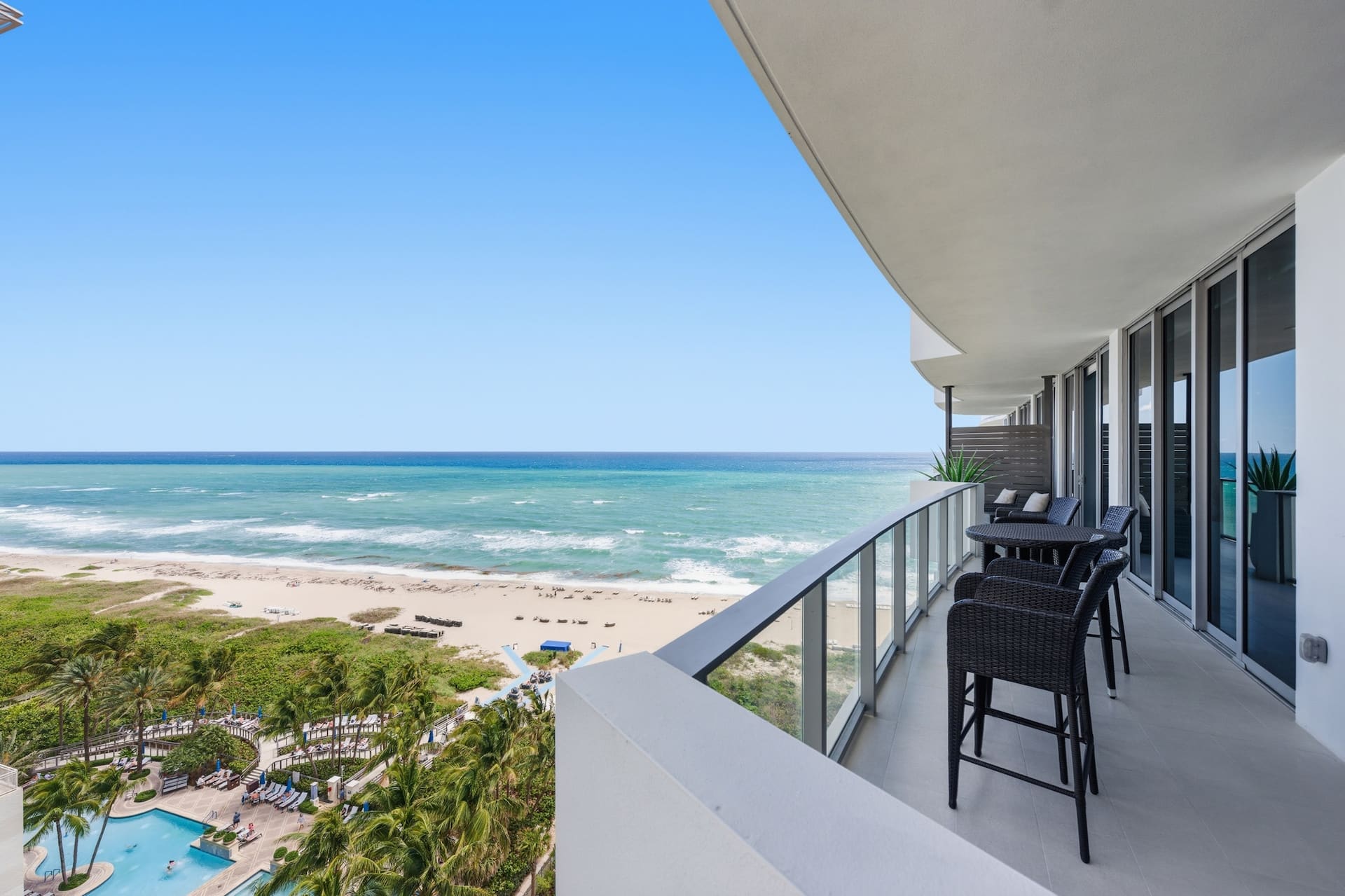
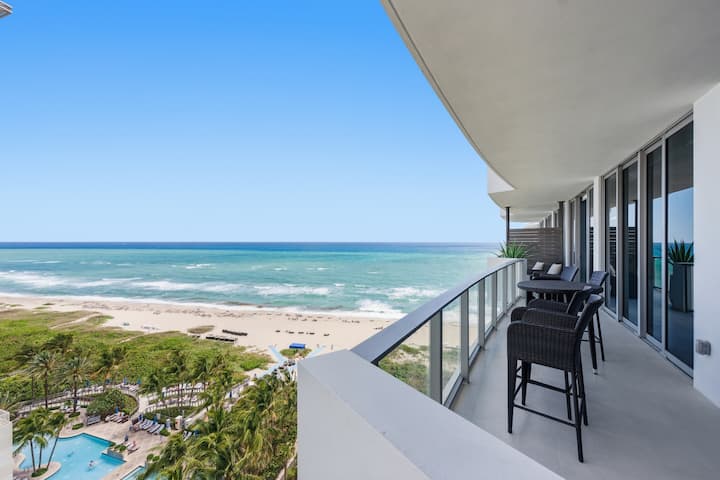
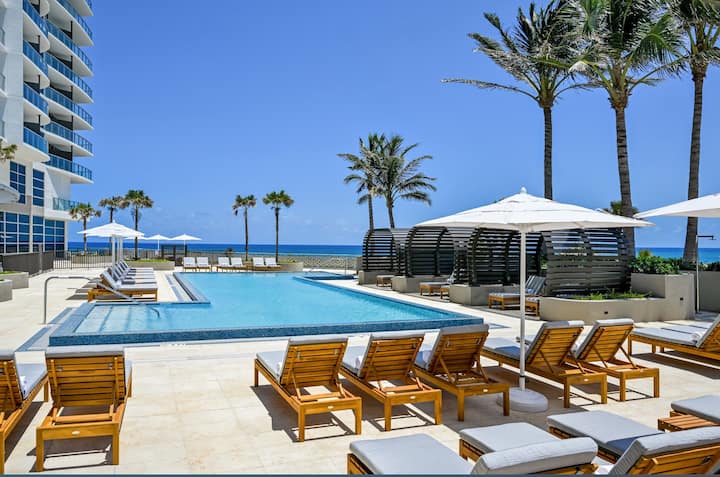
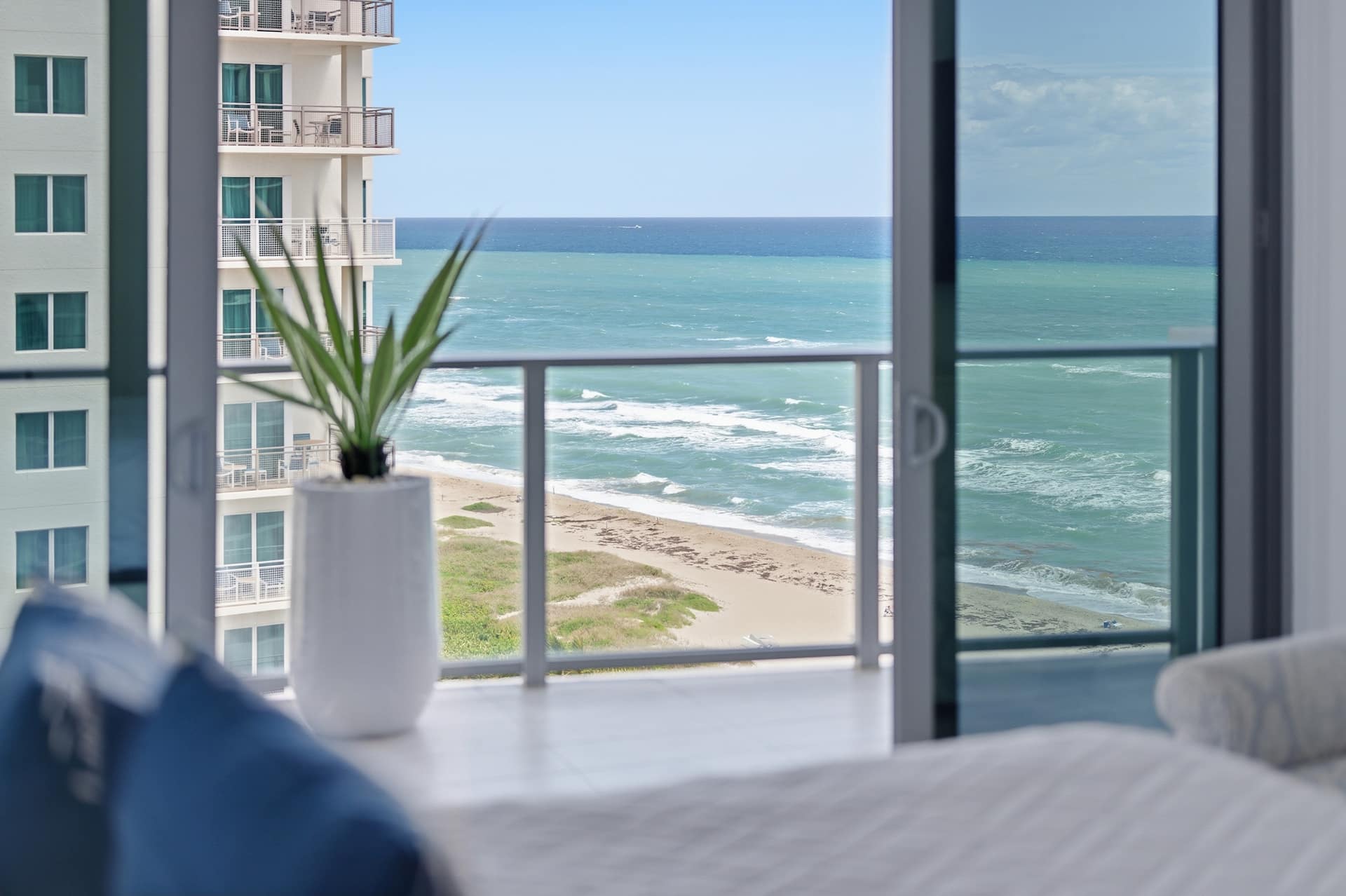
OASENA is a private two-bedroom home on the twelfth floor of the Happiness Tower — floor-to-ceiling ocean views, a sweeping balcony, and this entire wellness world an elevator ride below.
OASENA is a privately owned residence within Amrit Ocean Resort & Residences and is not operated by, affiliated with, or endorsed by the resort. See credits & notes.